How many air-conditioners you really need, and what to do about that bubble in the roof
Most people only deal with air-conditioning once it's too late: in August, in the south, where you can't sleep in the vehicle. Let's work it out sooner, and while we're at it, look at the roof windows, because they decide just how hard that AC will have to work.
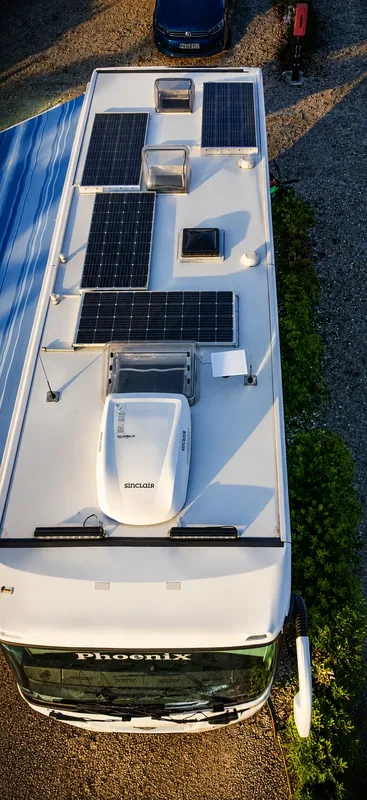
How much cooling makes sense for you
The number of units isn't set by the size of the vehicle, but by the combination of climate, length of stay and roof quality. The estimate is based on the heat load of the living space: how much heat the AC has to "bite off" to hold a pleasant ~22 °C inside.
2.2 kW · 7,500 BTU
An indicative estimate of the heat load, not a design specification. Actual demand is affected by insulation, orientation to the sun, shading and the chosen unit. One roof unit ≈ 3.4 kW of cooling (Sinclair / Dometic / Truma inverter). We confirm the exact design individually.
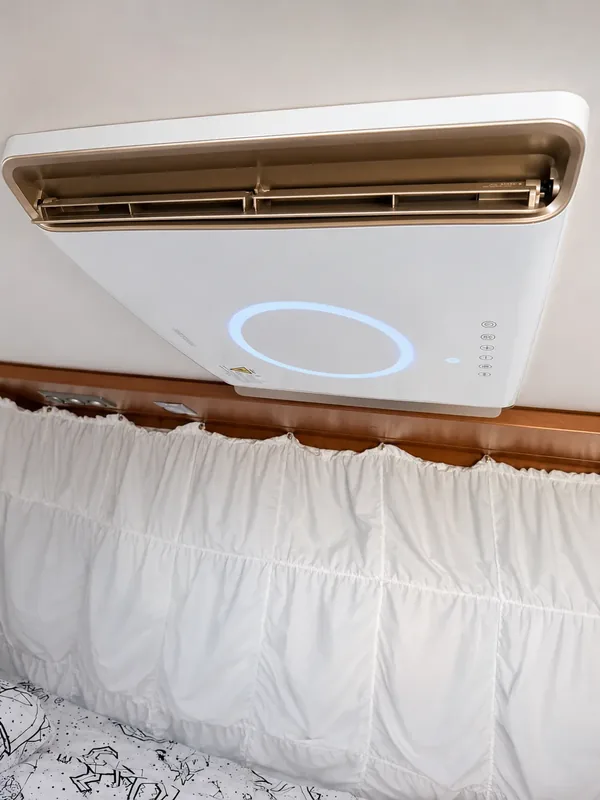
Why a second AC only arrives in the extreme
For an ordinary Central-European summer, one quality inverter unit is comfortably enough, and the inverter is the key, because it modulates smoothly and is quiet at night. A second unit only makes sense where the temperature stays above 30–35 °C for long stretches and you genuinely live there, not just at weekends. By then a single unit is running flat out and still can't keep up.
↳The roof window as a thermal hole
It's no accident that some premium brands (Concorde, for instance) often don't fit roof windows at all. A large plastic "bubble" (Heki) is a hole in an otherwise insulated ceiling: in winter heat escapes through it, in summer it relentlessly lets heat in, and that is exactly the extra work the AC then has to handle.
 Plastic bubble (Heki)THERMAL HOLE Premium tempered glassYACHT LEAGUE
Guiding rule
We can make a hole in the roof bigger, not smaller. So we always start from the existing cut-out and look for a solution that fits it with minimal cutting.
You then have essentially two routes:
- Replace the glass: swap the plastic bubble for premium tempered glass (marine quality, stainless, walk-on, non-fogging). On a large panorama it's practically a like-for-like swap, without cutting.
- Turn the window into a spot for the AC: plate over an unused vent hatch with a reducing panel; a roof AC needs only ~400 × 400 mm, so the existing hole is comfortably covered and nothing is cut.
The exact window dimensions must always be confirmed from the frame label or the actual cut-out in the roof: nothing is cut from a photo or a rough measurement taken inside.
€Roughly what it costs
| Standard replacement (Carbest / Midi Heki) | ~150–480 € |
| Panorama Heki 3 / Heki 2 (back to plastic) | ~450–1 000 € |
| Premium tempered glass (KC HartGlas, "yacht" league) | ~3 800–4 700 € |
| Roof air-conditioning (inverter, incl. adapter) | ~1 100–1 400 € |
Premium glass is an order of magnitude dearer than the original Heki, it's the price "for the bubble you no longer want". Whether it pays off is exactly the question we'll help you work out on your specific vehicle.
Roof and air-conditioning photography © Phoenix 8200 Lab (phoenix7.cz), published with the author's permission.
Have it worked out on your own vehicle
How many units, which window, what payback: on your specific Morelo, Concorde or Phoenix. We'll go over the roof with you, measure the cut-outs and recommend a solution that makes sense for you, not for a catalogue.
Arrange a consultation →